
How should a dental practice compare AI x-ray analysis programs before buying one?
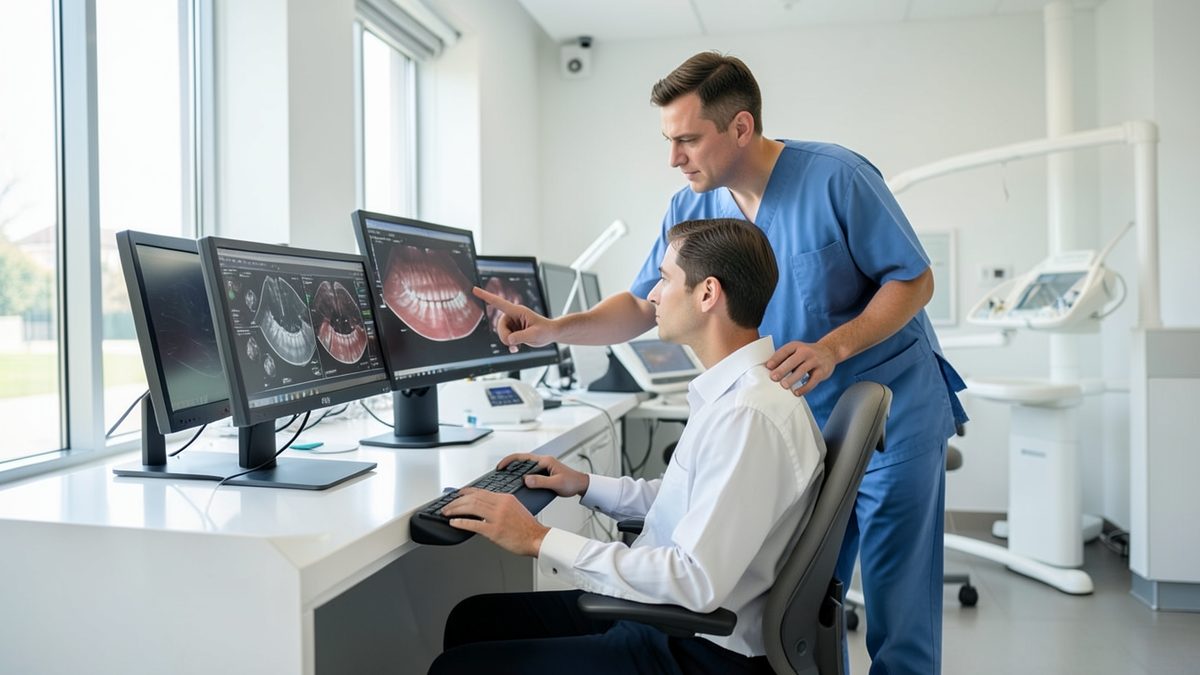
AI x-ray software is a program that scans dental radiographs and marks suspected findings, such as caries, for the dentist to review. To compare programs before buying, check which findings and image types each one is FDA cleared for, ask for independent validation studies, confirm it fits your practice management and imaging setup, and trial it on your patients' x-rays.
What does FDA clearance cover for AI x-ray software?
FDA clearance is tied to specific indications, meaning particular findings on particular image types. Overjet puts it plainly in its 2026 buyer guide: "Clearance attaches to an indication, not to a company." In practice, open the November 2025 summary from the U.S. Food and Drug Administration for Pearl's Second Opinion Panoramic, filing K250525. Read the indications, image types and eligible patient ages, then match them to your intended use.
According to a 2025 review in the International Dental Journal, 13 companies offered 29 FDA-cleared AI products for dental imaging. This week, list the image types your office takes most and the findings your dentists care about. Then ask every vendor for the 510(k) number behind each one, and read the indications yourself. Any advertised finding missing from the cleared indications goes on your sheet in red.
Who tested the accuracy, and on whose x-rays?
An accuracy number is only as strong as the study behind it, so ask who ran that study. According to the American Dental Association, its standards work highlights "the need for an independent dataset to validate AI algorithms used to analyze 2D dental images." Ask each vendor for the published study behind its claims, who ran it, and whether the x-rays came from practices outside the company's own data.
Even Overjet's guide concedes that "internal accuracy numbers with no study behind them stay unverified." For instance, bring the March 2026 paper by Carolina Ganss and Kirstin Vach in Caries Research to the evidence discussion. Ask how each study defined a cavity, what threshold triggered a flag, and how common the condition was in the test cases.
Will your team use the AI x-ray software every day?
Daily use is the true test of a good fit. Overjet's checklist describes one approach: "Integration means the AI loads inside your practice management system and providers actually use it daily." Test each finalist with your own practice management and imaging software, on your version. Dr Joshua Austin, DDS, reviewing Pearl for Dental Economics in 2023, described software that "lives on your imaging server and analyzes every radiograph taken by your practice."
Likewise, Dr Joshua Prentice, DDS, wrote in Glidewell's Chairside Magazine in 2023 that Overjet analyzes new scans "without my input." Ask each finalist to show that on your setup, and log any manual uploads. Plan for a mixed reception, though. When researchers followed a real rollout for Frontiers in Oral Health in 2025, provider "confidence in the ability of the AI software to improve diagnosis of dental caries and periodontal disease and its ability to improve the efficiency of their work was mixed." That group included hygienists and assistants as well as dentists, so bring them into the first hands-on test.
How should you run a trial before you sign?
A fair trial is a test on your own x-rays, using the same cases for every finalist. Pull recent cases whose findings the dentist has already established through exam or treatment. Next, the dentist compares every AI flag with that known list and logs each false alarm. Missed findings need a separate pass. A miss never appears as a flag, so the dentist works down the known list and records each finding the program failed to mark.
The office manager owns the scoreboard during the trial. Track flags reviewed, false alarms, missed findings, treatment-plan changes accepted by the dentist, and time added to visits. Keep each finalist on its own row so the totals compare cleanly.
What are the risks of buying AI x-ray software too fast?
One risk is a program that performs poorly on your own images. In 2026, one dentist told the ADA Health Policy Institute, "I've tried it with x-ray reading and it was about 30% accurate. It needs more time." However, that is one respondent's estimate, so ask each vendor for measured results instead of treating it as a benchmark. In addition, Dr Ahmad Al-Hassiny of the Institute of Digital Dentistry asked in 2024, "So, would I rely on Pearl's Second Opinion entirely? No." He added, "Nor do I think that is the intention."
That said, the contract carries risk too. Before sharing patient x-rays, ask where images go, who can access them, whether they are used to train models, and how they can be deleted. Before signing, ask for written pricing and any setup charges, who handles training and support, and how you exit with your data.
What goes on a vendor vs vendor comparison sheet?
A comparison sheet is one table you fill in for every finalist before you ask for a contract.
| Question | What a strong answer looks like | Where you check |
|---|---|---|
| Which findings and image types are cleared? | A 510(k) number for each finding, such as K250525 | The FDA summary document |
| Who validated the accuracy? | A published, independent study, since a 2025 review of 29 cleared products found gaps | The journal article the vendor names |
| Does it work with your systems? | Works with your practice management and imaging setup | A hands-on test on your own setup |
| How did it score on your x-rays? | Dentist-checked flags plus a separate count of known findings it missed | Your trial log |
| Where do patient images go? | Written answers on storage, access, model training and deletion | The vendor's written terms |
| What will it cost, and how do you leave? | Written pricing, setup charges, support duties and exit terms | The draft contract |
An AI flag is a mark on the screen, while a finding is what the dentist accepts after reviewing the image. Only accepted findings belong in treatment planning. Before the contract starts, decide where accepted findings are recorded and who schedules any agreed follow-up. For the scheduling and follow-up steps around the program, see AI automation for dental practices.
FAQ
Does FDA clearance mean an AI x-ray program has been independently proven?
FDA clearance and independent proof are separate checks. According to a 2025 review in the International Dental Journal, 13 companies offered 29 FDA-cleared AI products for dental imaging, yet several newer platforms lacked independent clinical validation. As a result, ask every vendor for its published study and for the 510(k) number behind each finding.
Can AI x-ray software replace the dentist's own reading?
AI x-ray software works as a second look, so keep the dentist's own reading in charge of every diagnosis. In a 2024 review for the Institute of Digital Dentistry, Dr Ahmad Al-Hassiny asked whether he would rely on Pearl's Second Opinion entirely and answered no. He added that he did not think that was the intention.
How many dentists use AI for x-rays today?
According to the ADA Health Policy Institute in July 2026, 22.8% of responding dentists reported using AI for imaging and diagnostics, around one-fifth of those who answered. That share describes current use among respondents, so judge each program on its own trial results, using your x-rays and your dentist's review, before you sign.
Sources
- American Dental Association, undated page, read November 21, 2026: https://www.ada.org/resources/practice/dental-standards/artificial-intelligence-in-dentistry
- U.S. Food and Drug Administration, November 2025: https://www.accessdata.fda.gov/cdrh_docs/pdf25/K250525.pdf
- Overjet, August 4, 2026: https://www.overjet.com/blog/dental-ai-buyers-guide
- Caries Research, Carolina Ganss and Kirstin Vach, March 26, 2026: https://karger.com/cre/article/doi/10.1159/000551765/946962/Rethinking-Diagnostic-Performance-Metrics-in
- International Dental Journal, Sohaib Shujaat and colleagues, December 19, 2025: https://pmc.ncbi.nlm.nih.gov/articles/PMC12775797
- Frontiers in Oral Health, Slashcheva LD and colleagues, February 14, 2025: https://www.frontiersin.org/articles/10.3389/froh.2025.1473877/full
- ADA Health Policy Institute, July 2026: https://www.ada.org/resources/research/health-policy-institute/dental-practice-research/dentists-ai-usage-and-attitudes
- Dental Economics, Joshua Austin, DDS, MAGD, June 21, 2023: https://dentaleconomics.com/science-tech/article/14291898/product-review-second-opinion-by-pearl-ai
- Institute of Digital Dentistry, Dr Ahmad Al-Hassiny, November 5, 2024: https://instituteofdigitaldentistry.com/ai/second-opinion-by-pearl-ai-assisted-dental-radiography-review/
- Glidewell Dental, Joshua Prentice, DDS, November 28, 2023: https://glidewelldental.com/education/chairside-magazine/volume-18-issue-2/overjet-ai-bringing-ai-into-the-forefront-of-x-ray-analysis
If you want a second set of eyes on your shortlist and the workflow around it, book a call with us.