
Can AI check patient insurance eligibility for a dental front office?
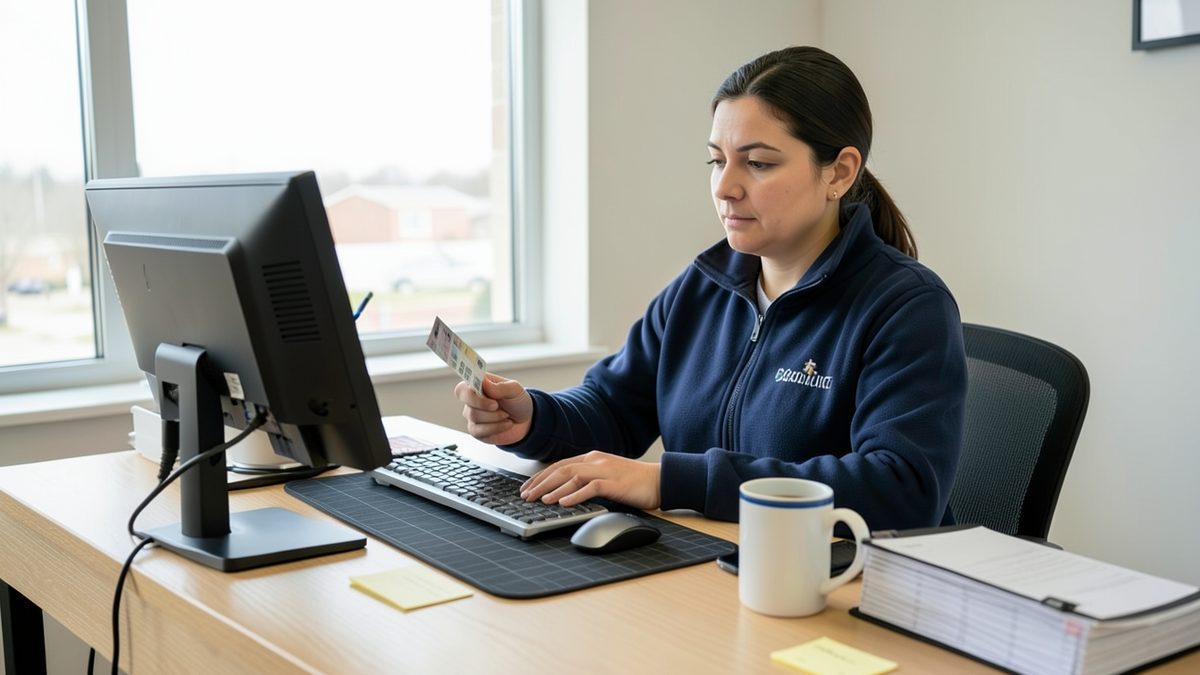
Dental insurance eligibility is the check a front office runs before a visit to confirm a plan is active and to record the plan's stated benefits. Yes, AI can run the routine parts of that check. A person still handles thin payer responses and exceptions. Eligibility must also be rechecked on the date of service.
What is the front office actually checking?
Before a patient sits down, someone at the desk checks whether the plan is active and records its stated benefits. AI Dental Tools describes that record: the annual maximum left, the deductible, coverage percentages, how often the plan pays for exams, cleanings and x-rays, waiting periods, and clauses such as a missing tooth or a downgrade.
The American Dental Association says staff usually verify through the payer's online portal or by calling the toll-free number on the card. It is essential to verify eligibility on the date of service, to avoid recoupment requests later. A portal or call-center answer may not be up to date, or otherwise accurate.
Can AI run the routine parts of that check?
For the fields a payer actually returns, yes. Nate Anderson at Teero puts it plainly. AI can take over routine eligibility checks, plan maximums, deductibles, and coinsurance percentages. It struggles when the answer depends on information the payer did not return, such as prior crowns at another office, coordination of benefits, or waiting periods. Teero says those exceptions still need someone to call the payer, ask a specific question, and document the answer.
Open Dental describes the same limit inside its own dental practice software. Electronic eligibility can show percentages, deductibles, maximums, limitations, and history in real time. Any of that can be imported. It still takes a human to interpret the data. Most carriers still send very sparse data, frequently nothing more than a single yes or no on whether the patient is covered.
Why is a bare electronic answer often not enough?
ADA News reports on the 2024 CAQH Index, a health care industry benchmarking tool for electronic administrative transactions, built on data from 2023. It describes how the check gets done. Fully electronically, through an automated transaction that HIPAA requires to meet certain standards. Partly electronically, through a plan portal. Or manually, by phone, fax, email, or mail. The largest increase in administrative spending in the dental industry came from eligibility and benefit verification, which rose 15% to $2.1 billion.
A newer edition, the 2025 CAQH Index Executive Report, says dental administrative spending decreased 4% to $6.6 billion.
The same ADA News article quotes Mark A. Moats, D.M.D., chair of the ADA Council on Dental Benefit Programs. He says providers indicated in the CAQH Index that they often do not obtain strong enough information through the automated transaction to be reliable.
AI Dental Tools explains the electronic route this way. Your practice software sends a 270 eligibility request through your clearinghouse, and the payer returns a 271 response. It says verification software fills the gap between a thin 271 and a phone call.
Two vendors describe their own tools. Weave's news release says its customers can "automatically retrieve real-time data from insurance portals." Dentrix Ascend Eligibility Pro, on the Dentrix Ascend Resource Center, "scours payers' online portals, pulling in more data than are usually received."
Cigna Healthcare said that starting April 24, 2026, medical, dental, and behavioral health providers would see improvements to its 270/271 eligibility and benefits transactions. The number of remaining visits and services is returned when maximum benefit limitations apply, and if a benefit has been exhausted, the next eligible date is returned. The notice lists asking by procedure code as a planned later phase.
Check what each of your biggest payers actually returns.
What does 5 hours a week cost the office?
Parkhurst Consulting published an example that begins with an assumption. Assume insurance verification takes 5 staff hours each week at a loaded labor cost of $25 per hour. That is $6,500 per year. A $200 monthly tool costs $2,400 per year, so it needs to save about 1.85 hours each week to cover the subscription.
| Line in the example | Figure |
|---|---|
| Weekly staff time on verification | 5 staff hours |
| Loaded labor cost | $25 per hour |
| Yearly labor if those hours stay | $6,500 |
| A $200 monthly tool | $2,400 per year |
| Time the tool must save to cover the fee | about 1.85 hours each week |
Use the table as a break-even test, not as your result. If verification already takes less time than the tool must save, the fee does not pay for itself on labor.
What should you set up before you turn it on?
Dr. James Younger of TempStars lists checking eligibility and insurance coverage before the patient arrives as one of three low-risk places to start.
45 CFR 164.502 sets the federal floor. A covered entity may let a business associate handle protected health information if it obtains "satisfactory assurance that the business associate will appropriately safeguard the information." Those assurances "must be documented through a written contract or other written agreement or arrangement with the business associate." It asks for reasonable efforts to limit that data to the minimum necessary. Get a written business associate agreement (BAA) and send only the fields the check needs.
Measure the staff time spent on verification each week and compare it with the 5-hour example.
Then read a stack of recent electronic responses and mark how many are only a yes or no, the pattern Open Dental says most carriers still send. Write down the exceptions your team already calls about: prior treatment at another office, coordination of benefits, waiting periods. Teero says those still need a person on the phone. Ask each vendor how its tool flags missing information for your staff to review, and test it on your own exceptions.
Before any patient identifier leaves your system, ask the vendor about a BAA, and have whoever handles privacy and IT for your office read the setup. Keep the date-of-service recheck on the schedule. An earlier portal answer can already be stale.
If you want that setup planned around the software you already run, see AI automation for a dental front office.
FAQ
Does the office still verify eligibility on the day of the visit?
Yes. The American Dental Association says it is essential to verify eligibility on the date of service, to avoid recoupment requests later. It also warns that a portal or call-center answer may not be up to date.
Who calls the payer when the electronic answer is thin?
Teero says a person still needs to call when the payer did not return the fact you need, such as prior crowns at another office, coordination of benefits, or waiting periods. Open Dental adds that most carriers still send very sparse data, often only a yes or no on coverage. Ask each vendor how its tool flags missing information for your staff to review.
How many hours must a tool save to cover a $200 monthly fee?
In the Parkhurst Consulting example, a $200 monthly tool costs $2,400 a year. At a loaded cost of $25 per hour, it needs to save about 1.85 hours each week to cover the subscription.
Sources
- AI Dental Tools, AI Dental Tools Editorial, November 2, 2026: https://aidentaltools.com/practice-ops/dental-insurance-verification/
- American Dental Association, undated page, read November 3, 2026: https://www.ada.org/resources/practice/dental-insurance/eligibility-verification
- Teero, Nate Anderson, October 23, 2026: https://www.teero.com/blog/ai-dental-insurance-verification-what-it-handles-well-and-where-humans-still-win
- Open Dental Software, undated page, read November 3, 2026: https://opendental.com/manual/ebenefits.html
- ADA News, Mary Beth Versaci, March 24, 2025: https://adanews.ada.org/ada-news/2025/march/benefit-verification-drives-increased-administrative-spending-in-dental-offices
- CAQH, undated page, read November 3, 2026: https://index.caqh.org/hubfs/Index/CAQH_IndexReport_2025_Executive%20Report_v6.pdf
- Weave, February 18, 2026: https://s21.q4cdn.com/507868397/files/doc_news/Weave-Unveils-RPA-Powered-Insurance-Eligibility-Dramatically-Improving-Dental-Verification-Rates-and-Practice-Reimbursement-Accuracy-2026.pdf
- Dentrix Ascend Resource Center, Gentry Winn, August 28, 2024, updated July 18, 2025: https://learn.dentrixascend.com/dentrix-ascend-eligibility-pro/
- Cigna Healthcare, April 24, 2026, updated July 22, 2026: https://providernewsroom.com/cigna-healthcare/enhancements-to-the-270-271-eligibility-and-benefits-transactions-to-give-faster-and-clearer-results/
- Parkhurst Consulting, July 30, 2026: https://parkhurstconsulting.com/resources/ai-in-dental-practices-2026-ada-survey-on-adoption-and-use-cases
- TempStars, Dr. James Younger, DDS, October 26, 2026: https://www.tempstars.com/front-desk-ai-tools-dental-practice/
- Electronic Code of Federal Regulations, undated page, read November 3, 2026: https://www.ecfr.gov/current/title-45/subtitle-A/subchapter-C/part-164/subpart-E/section-164.502
If eligibility checks are taking the morning, book a call.